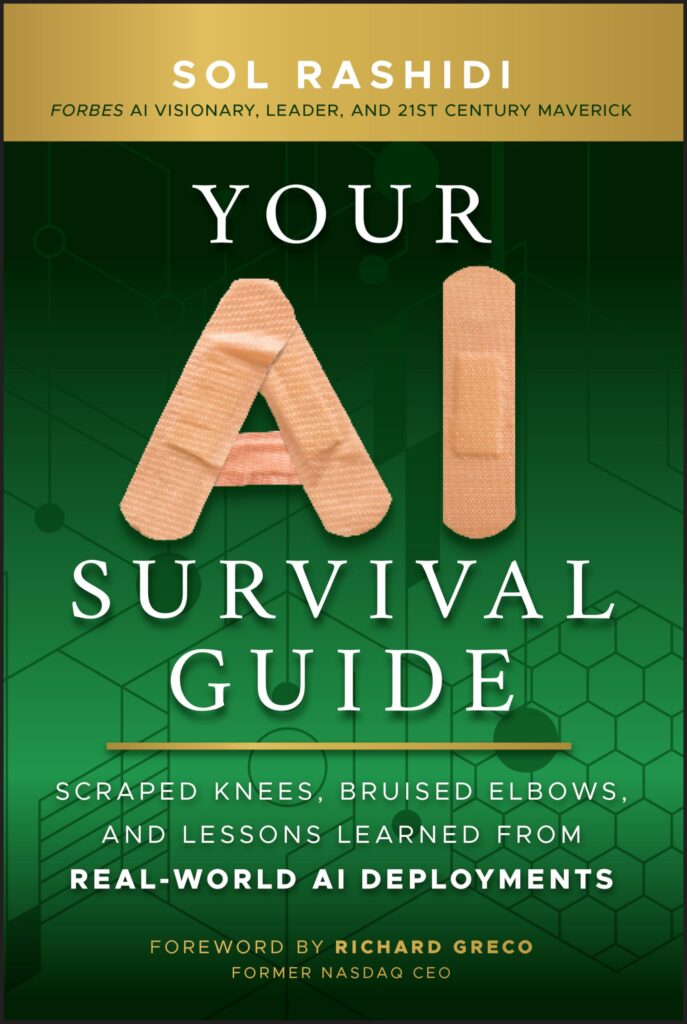
What do I love about: Your AI Survival Guide?
I love that it is comprehensive, easy to digest and apply. It is not only a survival guide but also a practical one.
What do I not love about: Your AI Survival Guide?
There is nothing I don’t love about it
Who should read: Your AI Survival Guide?
Professionals, small business owners, leaders
Who should not read: Your AI Survival Guide?
Experts and AI researchers as it may come across as too fundamental.
Notes about Your AI Survival Guide?
- The journey of AI is a critical step in maintaining your market position and ensuring personal and professional relevance in the changing landscape.
- To sum up, my competence and personality got me hired, my relentless pursuit in persuasion got the company started, and my determination got the company past the finish line.
- As a business leader, business owner, executive, peer and teammate, or practitioner, you quickly learn that who you surround yourself with has the greatest impact in your life. It is the number one factor in shaping your present and future.
- My biggest lesson in life was learned when I transitioned to the C-suite ranks of Corporate America. I learned that my success depended less on my IQ and more on my EQ and SQ. I had to master common sense, speak “plain English”, articulate business value, and make everything we did about the business we served.
- I also learned that 70% of my time was spent on aligning, evangelizing, and selling the innovation where investments were needed to get the job done.
- Bending the rule is a strategic endeavor not an act of rebellion.
- The reason AI projects don’t succeed is not because of experience per se but because ; companies don’t know how to start so they don’t start, companies start but can’t get consensus, companies have too many competing priorities so no focus and funding, companies do not know how to scale after PoCs.
- While technology, processes and best practices can be taught, there are three virtues that cannot; grit, ambition and resilience. The innate desire to make an impact and explore new ventures is a rare quality.
- Include naysayers in requirements and design since their default reaction is to spot problems but do not involve them in vision and strategy discussion.
- Humans in the loop is intrinsically connected to the movement toward responsible AI, which advocates for the use of AI in an ethical, governed and accountable way.
- .Education, media and entertainment are arguable the two industries being disrupted the most by AI
- If the answer isn’t a hard yes, then it is a NO.
THE FRAMEWORK TO CREATE CHANGE
- Ask WHY; make sure you know why you want to do this.
- Develop your AI strategy: The efficiency, effectiveness, productivity, growth and expert strategy
- Think big, Start small, Scale quickly
- Choose your technology partner: I do not recommend starting with a big management consulting firm. The market is saturated with AI advisors, AI strategists, and AI development firms. Interview a few and choose the one that aligns with your culture, is hungry, has strong development team and leader who would not switch and bait.
- Pace yourself
- Go through your normal estimation and add 30%. The 30% is your learning curve multiplier for AI
- Add your corporate multiplier from 25%-100%- fast, agile, decisive, and adaptation
- Your personal multiplier- your ability to influence, push and keep momentum
THE FRAMEWORK FOR AI INITIAITIVES
Phase 1 : AI readiness assessment
Provides questionnaire on market strategy, business understanding, workforce acumen, company culture, role of technology, and data
Phase 2: Selecting an AI strategy
Introduces 5 strategies- efficiency, productivity, effectiveness, expert and growth strategies. Productivity and efficiency are more applicable to low readiness organizations and the higher readiness is for growth, effectiveness and expert strategies.
Phase 3: Creating and selecting use cases
- Have your strategic thinkers, discerners, galvanizers, innovators, business partners, cofounders or anyone else who has a growth mindset.
- Prioritize using the criticality vs complexity quadrant.
- Criticality-impact sales & growth, impact operations, culture and public perception
- Complexity-skills, change, resources and infrastructure required
Phase 4: Preparing and designing
- Use the essential check list- vision, impact, support, approach and process
- Always start with the “Why” and share it with everyone. Be passionate about it. Be secure with it. Be confident with it (even if you are not at times).
- Malcolm Gladwell once said it takes 6 times to repeat something for it to be remembered and nearly 23 times to repeat something for the content to be heard. Don’t assume everyone understood the vision the first time you communicate it. Restate it. When you think you are done, repeat it all over again.
- Hand select individuals who have a track record for driving change, have a “can-do” attitude, and are gritty, ambitious, and resilient. Surround yourself with reliable and hungry people so that the weight and burden does not fall completely on your shoulders. You need other rogue leaders with you regardless of their level or role.
- Be deliberate in your thinking but swift in your decision and act.
- The biggest gotcha with PoCs is that they often take too long, losing the attention span and support of the powers that be.
Phase 5: Selecting and creating solutions
When selecting companies with solutions, the goal is to assess the longevity so when you make the investment, you can feel good about their staying power.
Phase 6: Deploying and going live
In your communications, reiterate how AI will amplify their work, accelerate current workloads and automate mundane and repetitive tasks. Repeat the message until it sticks
6 Tenets of Responsible AI
- Transparency: How AI systems are being used to build trust
- Accountability: Having measures in place to address any issues or harm that AI systems may cause
- Fairness: AI models and algorithms need to be free from bias
- Privacy: Protecting sensitive data and respecting user consent.
- Inclusiveness: The need for AI to be accessible to diverse populations, respecting and embracing differences
- Diversity and nondiscrimination: Reducing bias in AI algorithm using diverse and representative data
How AI is Impacting Industry
- Farming: Precision farming (data from multiple sources), disease and pest control (image recognition)
- Travel & Leisure: facial recognition, chatbots & virtual agents, dynamic pricing & route availability
- Manufacturing: predictive maintenance, quality control and inspections, robotics
- Retail: personalized recommendations, chatbots, virtual try-ons
- Media & entertainment: content creation, targeted advertising, deepfakes, music compositions
- Healthcare: robot assisted surgery, wearables, disease diagnosis (using image recognition)
- Consumer electronic: smart home devices- tv, speakers, thermostats, security systems etc.
- Fashion and Apparel: Trend prediction, AI-powered stylist
- Education: learning platforms, language learning, personalized learning
- Food and beverages: quality control & inspection, waste management
- Environment Health and Safety: hazard identification, emissions control, wearables
How AI is Impacting Functions
- Legal: Contract review and analysis, legal research, e-discovery
- Procurement: Contract analysis, vendor risk management, compliance monitoring
- PMO: Risk prediction & management, resource allocation models, task automation
- Human resources: resume screening, chatbots for employee questions, predictive recommendations i.e turnover
- Customer service: knowledge base, sentiment analysis, triaging
- Sales: customer calls and followups, sales presentations
- Training and development: intelligent training systems, content generation and curation
- Finance: Expense categorization, financial planning, budget allocation and forecasting
- Marketing: programmatic advertising, SEO and website optimization, automated email marketing
Statistics
- AI has proven to improve productivity of 61% of employees
- Agents who use AI can handle 13.8% more customer inquiries per hour
- Business professional who use AI can write 59% more business documents per hour
- Programmers who use AI can code 126% more projects per week.
- 54% of organizations state that AI has been a cost-effective measure for their business operations.
- It takes a minimum of 6 months of training before a new hire can take calls on their own