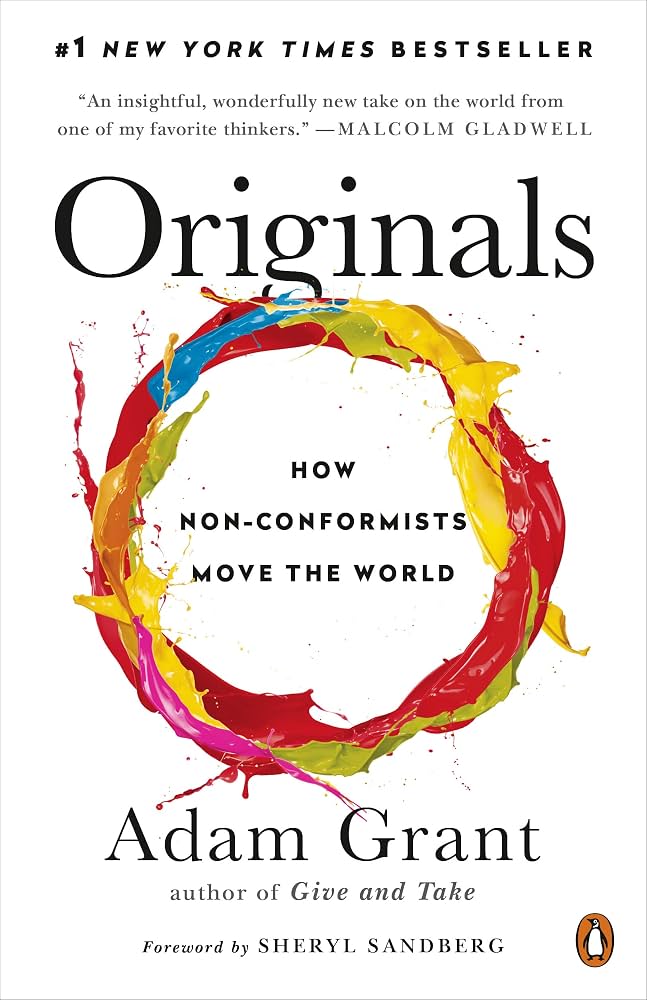
To read the full PDF version (TBD)
To listen to the full audio version (TBD)
To purchase and/or read additional reviews, see Amazon page here
What do I love about: Originals?
I love how the author provides counterintuitive ideas but also shows when the conventional approach and what makes the counterintuitive better. These ideas are grounded in extensive research spanning different areas of life such as politics, entertainment, education.
What do I not love about: Originals?
I found it sometimes dense to read.
Who should read: Originals?
Anyone who likes to discover new ideas of go against the conventional grain of thinking.
Who should not read: Originals?
Anyone who is not into self-help.
Notes about Originals?
Chapter 1: Creative Destruction
• There are two routes to achievement: conformity and originality.
• We are all vulnerable to “Kleptomnesia”- accidently remembering the ideas of others as our own.
• People who suffer the most from a given state of affairs are paradoxically the least likely to question, challenge, reject or change it
• The hallmark of originality is rejecting the default and exploring whether a better option exists
• Déjà vu occurs when we encounter something new, but it feels as if we have seen it before. Vuja de is the reverse- we face something familiar, but we see it with a fresh perspective that enables us to gain new insights into old problems.
• Practice makes perfect but it does not make new.
• The more you value achievement the more you come to dread failure. Instead of aiming for unique accomplishments, the intense desire to succeed leads us to strive for guaranteed success.
• If you are risk averse and have some doubts about the feasibility of your ideas, it is likely that your business will be built to last. If you are a freewheeling gambler, your startup is far more fragile.
• The greatest presidents were those who challenged the status quo and brought about sweeping changes that improved the lots of the country.
• You should be wary of being the first mover, because it is often riskier to act early than late.
Chapter 2: The Art and Science of Recognizing Original Ideas
• Creativity is allowing yourself to make mistakes. Art is knowing which ones to keep.
• Social scientist have long known that we tend to be overconfident when we evaluate ourselves.
• If you want to be an original, the most important thing you can do is do a lot of work. Do a huge volume of work.
• It is widely assumed that there is a tradeoff between quantity and quality- if you want to do better work, you have to do less of it-but this turns out to be false. In fact when it comes to idea generation, quantity is the most predictable path to quality.
• The more expertise and experience people gain, the more entrenched they become in a particular way of viewing the world.
• The unique combination of broad and deep expertise is critical for creativity.
• People who started businesses and contributed to patent applications were more likely than their peers to have leisure time hobbies that involved drawing, painting, architecture, sculpture and literature.
• Interest in the arts among entrepreneurs, inventors, and eminent scientist obviously reflects their curiosity and aptitude.
• Just as scientists, entrepreneurs and inventors often discover novel ideas through broadening their knowledge to include the arts, we can likewise gain breadth by widening our cultural repertoires.
• To accurately predict the success of a novel idea, it’s best to be a creator in the domain you are judging.
• To be a successful original, an invention needs to be new- but it also has to be practical.
• There is a hubris that comes with success.
• The more successful people have been in the past, the worse they perform when they enter a new environment. They become overconfident, and they are less likely to seek critical feedback even though the context is radically different.
• Intuition operates rapidly, based on hot emotions, whereas reason is a slower, cooler process. Intuitive investors are susceptible to getting caught up in an entrepreneurs enthusiasm; analytical investors are more likely to focus on the facts and make cold judgements about the viability of the business.
• The enthusiasm we inject into our words, tone of voice, and body language isn’t a clue to the internal passion we experience but merely a reflection of our presentation skills and our personalities.
• Since other companies could sell glasses online, the founders realized that branding would be critical to their success.
Chapter 3: Out on a Limb
• Great spirits have always encountered opposition from mediocre minds.
• Status cannot be claimed. It has to be earned or granted.
• The way to come to power is not always to merely challenge the Establishment, but first make a place in it and then challenge and double-cross the Establishment.
• Idiosyncrasy credits- the latitude to deviate from the group’s expectations. Idiosyncrasy credits accrue through respect, not rank: they’re based on contributions.
• When we are aware that someone is trying to persuade us, we naturally raise our mental shields.
• When people presents drawbacks or disadvantages, I would become an ally. Instead of selling me, they have given me a problem to solve.
• The benefit of leading with the limitations of an idea; it makes you look smart.
• Another advantage of being up front about the downsides of your ideas is that it makes you more trustworthy.
• Newtons 3rd law can be true in human dynamics as well: every action has an equal and opposite reaction.
• If we want people to accept our original ideas, we need to speak up about them, then rinse and repeat.
• Familiarity does not breed contempt.
• Exposure increases the ease of processing. An unfamiliar idea requires more effort to understand. The more we see, hear and touch it, the more comfortable we becomes with it, and the less threatening it is.
• You have a choice between EXIT, VOICE, PERSISTENCE & NEGLECT.
• At work, our sense of commitment and control depends more on our direct boss than anyone else.
• Voicing new revenue-generating ideas led to higher performance evaluations for men, but not for women. Other studies show that male executives who talk more than their peers are rewarded, but female executives who engage in the same behaviour are devalued by both men and women.
• For minority group members, it is particularly important to earn status before exercising power.
• If you become known as someone who delivers, you do your job and you do it well, you build respect.
Chapter 4: Fools Rush In
• Never put off till tomorrow what you can do the day after tomorrow.
• The most successful originals don’t always arrive on schedule. They are fashionably late to the party.
• Procrastination might be conducive to originality.
• Delaying progress enabled them to spend more time considering different ways to accomplish it, rather than “seizing and freezing” on one particular strategy.
• Employees who procrastinate regularly spent more time engaging in divergent thinking and were rated as significantly more creative by their supervisors. Procrastination didn’t always fuel creativity: if the employees weren’t intrinsically motivated to solve a major problem, stalling just set them behind. But when they were passionate about coming up with new ideas, putting off the task led them to more creative solutions.
• People have a better memory for incomplete than complete tasks.
• Procrastination provides time to generate novel ideas and keeps is open to improvisation. When we plan well in advance, we often stick to the structure we have created, closing the door to creative possibilities that might spring into our fields of vision.
• Great originals are great procrastinators, but they don’t skip planning altogether. They procrastinate strategically, making gradual progress by testing and refining different possibilities.
• The downside of being the first mover are frequently bigger than the upsides.
• Being original does not require being the first. It just means being different and better.
• First mover advantage tend to prevail when patented technology is involved or when there are network effects (the product or service becomes more valuable when there are a greater number of users, as with telephones or social media)
• Just as procrastinating can give us flexibility on a task, delaying market entry can open us up to learning and adaptability, reducing the risks associated with originality.
• Conceptual innovators are sprinters, and experimental innovators are marathoners
• To sustain our originality as we age and accumulate expertise, our best bet is to adopt an experimental approach. We can make fewer plans in advance for what we want to create, and start testing out different kinds of tentative ideas and solutions.
• Yet for those of us who aren’t struck by a bolt of insight, slow and steady experimentation can light the way to a longer stretch of originality.
Chapter 5: Godilocks and the Trojan Horse
• We assume that common goals bind groups together, but the reality is that they often drive groups apart
• Even if they care about different causes, groups find affinity when they use the same methods of engagement.
• Keep your friends close, but your enemies closer.
• It takes more emotional energy and coping resources to deal with individuals who are inconsistent.
• Having more ambivalent relationships predicted higher rates of stress, depression, and dissatisfaction with life.
• Our instinct is to sever our bad relationships and salvage the ambivalent onces. But the evidence suggest we ought to do the opposite: cut our frenemies and attempt to convert our enemies
• We regard someone who began as a rival and then became an enthusiastic supporter as an authentic advocate. A person whose liking for us increases over time will be liked better than one who has always liked us.
• It is our former adversaries who are the most effective at persuading other to join our movements. They can marshal better arguments on our behalf, because they understand the doubts and misgivings of resisters and fence-sitters.
• If it is not original enough, its boring or trite. If its too original, it may be hard for the audience to understand. The goal is to push the envelope, not tear the envelope.
Chapter 6: Rebel with a Cause
• Overall, late borns were twice as likely as firstborns to champion major scientific upheavals.
• One analysis of more than 1,500 CEOs revealed that 43 percent were firstborn
• First borns are more risk averse than late borns.
• Later borns may find these first born preoccupations to represent distasteful quests for authority and conformity.
• Birth order does not determine who you are; it only affects the probability that you will develop in a particular way.
• Birth order was a better predictor or conformity and risk taking than I had expected.
• High achievers were 2.3 times as likely to be firstborns as lastborn. Rebels were twice as likely to be last born as first born.
• Although first born tend to be more dominant, conscientious, and ambitious, later borns are more open to taking risks and embracing original ideas.
• The niche of the responsible achiever is particularly likely to be open for an eldest child.
• Later born actively seek to be different.
• America’s most creative architects with a group of highly skilled but unoriginal peers, a factor that distinguished the creative group was that their parents exercised discipline with explanations.
• Children who received character praise were subsequently more generous.
• We should embrace nouns more thoughtfully. “Don’t Drink and Drive” could be rephrased as “Don’t be a Drunk Driver”. The same thinking can be applied to originality. When a child draws a picture, instead of calling the work creative, we can say “You are creative”. After a teenager resists the temptation to follow the crowd, we can commend her for being a non-conformist.
• If we want to encourage originality, the best step we can take is to raise our children’s aspirations by introducing them to different kinds of role models.
Chapter 7: Rethinking Groupthink
• Group think is the enemy of originality; people feel pressured to conform to the dominant, default views instead of championing diversity of thought.
• Dissenting opinions are useful even when they are wrong.
• The greatest tragedy of mankind comes from the inability of people to have thoughtful disagreement.
• Leaders do react more positively when employees bring solutions rather than problems to the table.
• A culture that focuses too heavily on solutions becomes a culture of advocacy, dampening inquiry. If you are always expected to have an answer ready, you will arrive at meetings with your diagnosis complete, missing out the chance to learn from a broad range of perspectives.
• Argue like you are right and listen like you are wrong.
• The more principles you have, the greater the odds that employees focus on different values or interpret the same values differently.
Chapter 8: Rocking the Boat and Keeping it Steady
• I learned that courage was not the absence of fear, but the triumph over it….. the brave man is not he who does not feel afraid, but he who conquers that fear.
• Strategic optimism and defensive pessimism. Strategic optimist anticipates the best, staying calm and setting high expectations. Defensive pessimists expect the worst, feeling anxious and imagining all the things that can go wrong. If you are a defensive pessimist, about a week before a big speech you convince yourself that you are doomed to fail. And it won’t be just ordinary failure. You will trip on stage and then forget all your lines.
• Defensive pessimism is a strategy used in specific situations to manage anxiety, fear and worry.
• The trick is to make fear your friend. Fear forces you to prepare more rigorously and see potential problems more quickly.
• Reframing fear as excitement also motivated the speakers, boosting the average length of their speeches by 29%.
• When we are not committed to a particular action thinking like a defensive pessimist can be hazardous. Since we don’t have our hearts set on charging ahead, envisioning a dismal failure will only activate anxiety, triggering the stop system and slamming our brakes. By looking on the bright side, we will activate enthusiasm and turn on the go system. But once we’ve settled on a course of action, when anxieties creep in, its better to think like a defensive pessimist and confront them directly.
• I found that the most inspiring way to convey a vision is to outsource it to the people who are actually affected by it.
• People are inspired to achieve the highest performance when leaders describe a vision and then invite a customer to bring it to life with a personal story. The leader’s message provides an overarching vision to start the car, and the user’s story offers an emotional appeal that steps on the accelerator.
• It is easier to rebel when it feels like an act of conformity. Other people are involved, so we can join too.
• After all, a bird in the hand is worth two in the bush.
• Is it better to highlight the benefits of changing or the cost of not changing? It depends on whether they perceive the new behavior as safe or risky. If they think the behavior is safe, we should emphasize all the good things that will happen if they do it- they’ll want to act immediately to obtain those certain gains. But when people believe a behaviour is risky, that approach doesn’t work. They’re already comfortable with the status quo, so the benefits of change aren’t attractive, and the stop system kicks in. Instead, we need to destabilize the status quo and accentuate the bad things that will happen if they don’t change. Taking a risk is more appealing when they are faced with guaranteed loss if they don’t. The prospect of a certain loss brings the go system online.
• If you want people to take risk you need to first show what’s wrong with the present. To drive people out of their comfort zones, you have to cultivate dissatisfaction, frustration, or anger at the current state of affairs, making it a guaranteed loss.
• Venting does not work even if you think it does-and even if it makes you feel good. The better you feel after venting, the more aggressive you get; not only toward your critic, but also toward innocent bystanders.
Actions for Impact
Individual Actions- Generating & Recognizing Original ideas
• Question the default
• Triple the number of ideas you generate
• Immerse yourself in a new domain
• Procrastinate strategically
• Seek more feedback from peers
Voicing and Championing Original Ideas
• Balance your risk portfolio
• Highlight the reason not to support your idea
• Make your ideas more familiar
• Speak to a different audience
• Be a tempered radical
Managing Emotions
• Motivate yourself differently when you are committed vs. uncertain
• Don’t try to calm down
• Focus on the victim not the perpetrator
• Realize you are not alone
• Remember that if you don’t take initiative, the status quo will persist
Leader Action- Sparking Original Ideas
• Run an innovative tournament
• Picture yourself as the enemy
• Invite employees from different functions and levels to pitch ideas
• Hold an opposite day
• Ban the words like love and hate
Building Cultures of Originality
• Hire not on cultural fit but on cultural contribution
• Shift from exit interviews to entry interviews
• Ask for problems not solutions
• Stop assigning devils advocates and start unearthing them
• Welcome criticism
Parent and Teacher Actions
• Ask children what their role models would do
• Link good behaviors to moral character
• Explain how bad behaviors have consequences for others
• Emphasize values over rules
• Create novel niches for children to pursue